Showing posts with label bees. Show all posts

Monday, August 24, 2015

Stinging Critters and Death Traps

I have yellow jackets living in my house. They aren't swarming around inside yet, but I can see where they are entering through a small hole under the outside molding. How big is the nest and where it's located, whether in the walls or floors or crawlspace, I have no idea. I would, however, like a house with less holes in it. I can see hundreds of yellow jackets going in and out all day long constantly. This is much like it was with the bumble bees last year. Problem is yellow jackets are vicious and I've been told they will fly all the way across the yard just to attack a person. Great.

Case in point, about two weeks ago I was out trimming back my daisies and buzzing critters were all over as usual. I didn't think anything of it. I plant bee-attracting flowers and I've never had a problem. Honey bees are very friendly and sweet. One buzzer started aggressively flying around me in a hostile fashion unlike a normal honeybee. I kind of backed away and he went away. I continued cutting the flowers. He didn't like that, landed on my arm, and bit me! Not a sting just a painful bite as a warning I guess. Totally premeditated. Very much like a yellow jacket and since I saw him close up, I can confirm it was a yellow jacket.  I got the message and left.

A few days later I was trimming the daisies in another part of my garden while keeping a close eye on my cutters which are quite sharp. I should have been watching where I placed my hand and I grabbed something with a stinger! I hadn't got stung since I was a kid. I don't remember it feeling like being electrocuted. With LOTS of pain. I used some baking soda and crushed plantain weeds and the pain and swelling subsided immediately leaving a red mark that itched for days. Then yesterday as I was out in the garden my neighbor's little three-year old granddaughter started howling high-pitched screams of terror, each one louder than the last. Yep, something stung her. I've noticed any time I wear my purple t-shirt, I get buzzed too close for comfort. I decided to take action.

I don't want to use smelly, toxic poison as I don't know if it will infiltrate into my inside air space so I got online and searched for ways to kill them. There are many instructions on how to build a homemade trap, but from what I understand this will just trap the workers and leave the queens to nest over the winter IN MY HOUSE! Hmmm...I may have to get some poison eventually, but I'll try this worker trap first.

I used a one-gallon plastic water jug. With an exacto knife or sharp instrument, cut an X into the sides of it, bending the sharp bits so they go inside. Make sure the holes are big enough to allow the yellow jackets in, but not too big so it's easy for them to get out. You want some to crawl out that way they'll go back to the nest and tell their friends about the yummy treats.


Next, make an attractant. In the spring yellow jackets are in need of protein so a piece of raw meat hanging from the top works well. Put a few inches of water in the bottom with a few drops of dish washing soap in the water. For some reason when they hit the water, the soap renders them incapable of getting out and they drown. Maybe the slippery stuff gets on their wings and legs?
 
Another recipe for death is something sweet like wine or apple juice. Since my apples are ripe and so abundant I can't even eat them fast enough, I decided to go this route.
 
 
Plus apples in the refrigerator...LOTS of apples this year!
 
 
I have lots of windfalls that the yellow jackets love. Place about 2-3 inches of apple juice in the bottom made from about ten apples. Skim the foam off it and add with a few drops of soap. Place the lid back on the jug.
 
 
I placed the jug on top of a ladder right next to the entry. I've been watching it all day. For some reason I thought they'd be all over it like they are with the windfall apples, but I do see two dark bodies so it's working. Slowly. I might need to replace the juice with wine. I think they'd like that better. I know I would.
 
I also made a trap with a small plastic water bottle. I think a big gallon soda pop bottle would work better, but I don't have access to one. For this type of trap, cut off the top 1/3rd of the bottle, invert it so the narrow spout is inside, place the sweet stuff in the bottom with a few drops of soap. It has not captured any yellow jackets, but I'll give it some time and see if one of my junk-food-eating neighbors has a gallon soda pop container.
 
I just hope these traps don't catch any honey bees.


REVIEW OF STINGING CRITTERS IN CASE YOU NEED A REFRESHER COURSE:

Yellow Jacket


Honey Bee
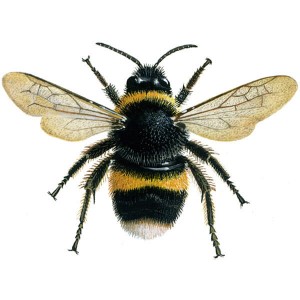
Bumble Bee

Wasp


Now what to do about the giant spiders coming in the house at night?

The Winter War is upon us...


Saturday, May 10, 2014

War of Stinging Things, Part 2

Plugging up the holes along one side of my house didn't do any good. The crafty bees have found another tiny hole and continue to go in and out. Bees are smart and will find a way in or out no matter what I do. So I searched online, called a pest control company, and found a beekeepers' club in my area. I also found an all-girl bee removal company out of town.

While waiting for my bee guy appointment, I did some more bee research. The pest control woman said they might be mason bees which are common. I got online to look at photos and read about different kinds of bees. Mine look mostly like bumble bees, but bumbles make nests in dirt, not in houses. Carpenter bees will make nests in houses, but they are more brown and black. My bees are brown/black with yellow and rust colored markings:

See tiny bee...click on photo to make it bigger for a better view.

What are bumble bees doing in my house and not in the ground in my garden somewhere? I really hate freeloading roommates. Doesn't matter if they are opossums, rats, mice, spiders, flies, mosquitoes, or...bees. Doesn't matter how beneficial to the earth or how helpful they are in my garden.
 
Bee guy emails me and says there are all kinds of honeybees. I can tell he's very hopeful that's what I have. I hate to tell people they aren't honeybees because no one seems to care about anything else. Bee guy comes and he's looking at the bees. He finally agrees with me they might be a type of bumble bee. OK, I was afraid of that. No one wants bumble bees; they want honeybees. Bumble bees are pollenators and, like honeybees, necessary to agriculture. Some species of bumble bees are endangered. Does this matter? Hmmm...bee guy looks a little disappointed, but he doesn't desert me. Yet.
 
Bee guy climbs up into the crawlspace above the laundry makes all kinds of exclamatory sounds...about the insulation and how thick it is. This goes on for five minutes and with every "ooooh" or "aaaahhh" I think he's found bees and I get excited. I know he doesn't want to be in the crawlspace as he mentioned before it's difficult to get bees out of a crawlspace, but he continues to look around. FINALLY, yes, he sees the hive! I have him take a photo of it:
 
The yellowy stuff.
 
He said it's sealed so there is no entrance into the house that he can see. He calls a beekeeping friend and they talk. We send photos to him. Bee guy confesses he doesn't know anything about bumble bees, but his advice is to leave the hive alone and in the fall he'll come back to see if it's grown. I get the feeling he's just trying to talk me into being satisfied with not having him do anything. That doesn't seem like a very good solution to me. I don't want it to grow! I also tell him I'm interested in selling the house so having a bee hive growing in it is not a good selling point. I try to discuss other options and he confesses he doesn't feel knowledgeable enough to remove them, nor young enough. It's obvious he just doesn't want to do it. Who cares about bumblebees?
 
I'm going to have to keep looking around for some help with this. I don't want to poison them, but I don't want to leave them alone to grow either. There should be a better solution.
 
In addition, this the first year in a long time hornet's are trying to make nests under my house eaves. I've knocked down two so far. My fake hornet's nests are useless. I'm very disappointed.
 
UPDATE: Bee Guy spoke to his Bee Guy friend and they decided if I wait until winter when the bee boy-workers all die leaving the queens in the hive, they will remove them and dismantle the hive. Bee Guy friend who knows bumble bees well said they are very opportunistic and they have found an abandoned wasp nest to use for the season. We don't want to kill them, just remove them from my house. I can wait. I'm happy to have them pollenate my garden.


Wednesday, April 16, 2014

Let the War Begin...Again.

Yesterday I happened to be out on my porch, enjoying the sunshine and fresh springtime air, and I noticed the soft buzzing of a bee. I enjoy bees. Hearing them buzz around the garden is a sign spring is here and that's always a happy sign. They pollinate my flowers and trees and I grow plants that will attract them. We have a mutually respectful, reciprocal relationship.

I smiled at the sound and looked up from what I was doing just in time to see a pretty little bee land on the side of my house and crawl IN THROUGH A SMALL HOLE under the siding. OH SHIT! I've seen online photos of giant hornet's nests or bee hives in the walls of houses. I watched for a few seconds as three or four more bees landed and disappeared. I ran upstairs to see if I could hear any buzzing in the walls. No. Then I ran to the hardware store in a panic.


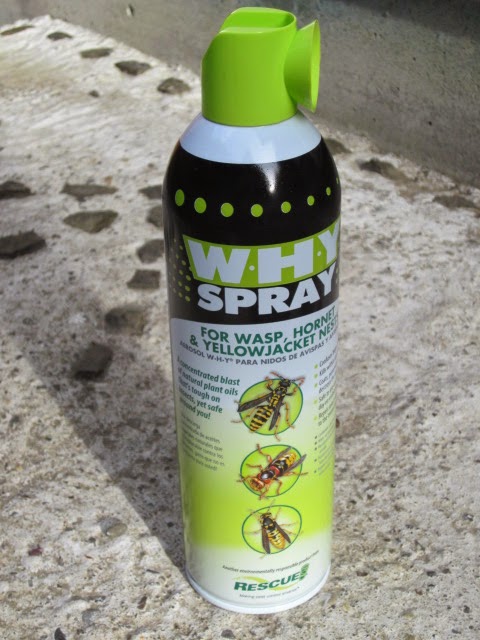
The hardware man's first suggestion was to use a fogger. No way. I think a fogger would kill me. Another suggestion was hornet traps, but those would attract every hornet and bee in the area and kill them. I just want to repulse them away. I don't want uninvited, free-loading roommates with stingers loading honey into my walls. Then someone suggested hornet spray even though I assured them I couldn't see a nest nor even knew where it was. Doesn't matter. The spray will confuse the bees and they will leave or die. There were also "green" or "safe" solutions rather than chemically-based sprays. The one I ended up buying is called WHY. Of course it costs twice as much as the chemical spray. The ingredients are: lemongrass oil, clove oil, rosemary oil, and geranium oil. I don't care for essential oils, but I've used a similar recipe to kill mold. I needed something and I'd be spraying it outside.

Covered in oil. Ewww.
I sprayed it on one side of the house where they were entering and hoped there wasn't another entry way. It stunk to high heaven, leaving oily drips down the side of the house, but tolerable. As I emptied the can I smelled a distinct alcohol smell, like rubbing alcohol. Yep, it has isopropyl alcohol in it, too, probably as a stabilizer for the oils or propellant. For the next hour I watched the bees frantically trying to figure out how to get into their hole, but unable to go near or land due to the stink. It seemed to be working. I kept an eye on them to see if they were flying into another entrance but it looked like they were flying away only to return to try a few minutes later. Hooray!

Later that evening as I went upstairs to bed the whole upstairs area smelled strongly of essential oils. Obviously they were getting into one of the crawlspaces in the roof. I prayed the bees wouldn't find a way into the house as they tried to escape the stink. I think this spray would work on spiders and rodents as well!

WRONG! It doesn't work on anything. Maybe that's why it's called WHY? WHY doesn't it work? Yes, the smell repelled them for a few hours, but by the next morning the smell had all but worn off and they were going in and out of the holes again. I raced again to the hardware store and bought some foam to plug up the holes. This stuff is a special recipe with pesticide in it although it doesn't smell much. I used it on the crawlspace as the instructions say bugs and rodents won't nibble on it because it tastes bad. Applying it sure is messy! By the time I finished plugging up the little holes I had the sticky, icky stuff all over. Seriously, I even dribbled it down the side of my face! The instructions say it comes off with acetone. No way! Or it'll wear off. I remembered tree pitch will come off with mayonnaise so I tried a mayonnaise facial. It removed the sticky part but the foam residue is still there. It looks like I have wrinkles. Well, more wrinkles. Uglier wrinkles.

Confused bee looking at globs wondering what the hell?
Again, I spent an hour watching the confused bees fly from one hole to the next not comprehending why they couldn't get past the unsightly glob of goo. They are very determined to damage my house. More than likely I've trapped the queen in my attic space. <shiver>

I got fed up with their never-ending determination so as soon as the foam was dry I grabbed the broom and started swatting them. They aren't going to return if they are dead! So much for our mutual respect and reciprocity. I have my limits.

So I armed with a broom and saw what I hope is the last living bee on earth. I swing...and the force of my killer swing forces me to step off the porch step. Unfortunately I thought I was on the last step and I wasn't. I overshot the last step, twisted my ankle, and fell smashing my foot into the cement. PAIN. Damn bees have now crippled me.

This house is a never-ending battlefield....

Monday, July 16, 2012

Herbicide Research and Chemical Company Revenge

Speaking of bees...The Organic Consumers Association just posted this article today on the sleaze of government and chemical companies. The local government destroyed a beekeepers hives without warning, killed his bees, and gave him some lame excuse. He had been researching the effects of Roundup on bees. Roundup is a deadly herbicide made by Monsanto. Monsanto didn't like that and went after him destroying years of research. Unbelievable. It's like we live in a police state....or a chemical state.

http://articles.mercola.com/sites/articles/archive/2012/07/05/monsanto-roundup-effects-on-honeybees.aspx?e_cid=20120715_SNLNew_MS_1

Saturday, July 14, 2012

Save the Bees

The bees are disappearing in record numbers. It is said if we cannot find a solution, they will completely disappear in ten to twenty years. Agriculture is dependent on bee pollination and without bees, our food supplies will turn to food shortages endangering our very existence.


Is that jetpack a superhero complex?
Colony Collapse Disorder (CCD) is caused by pesticides called neonicotinoids that were developed during World War II as nerve gases to support chemical warfare. The most common insecticides in this category are: acetamiprid, clothianidin, dinotefuran, imidacloprid, nitenpyram, thiamethoxam, and thiacloprid. They are sold under various brand names with cute logos not only as pesticides, but in combinations with fertilizers, herbicides and fungicides. Imidacloprid is the most common insecticide used world-wide and corn is the crop most often treated with it.


This guy sends me little cards in the mail requesting money
to support a cure for children's leukemia. Really?
The nerve of stupid people.
You can't imagine how much it irritates me.
Neonicotinoids are used on crops, golf courses, school playgrounds, parks, and residential lawns, gardens and homes. Their increased usage in the past ten years is contributing to the corresponding increases of cancer, kidney and liver disease, thyroid dysfunction, childhood learning disabilities, leukemia, and asthma. Since a dog's favorite activity is laying around on lawn, canine cancer is also on the rise.


I never see women spraying...
Hmmmmm?
The Environmental Protection Agency has done nothing but irresponsibly approve their use without the normally required testing, and the chemical industry has encouraged their overuse by up to three times the recommended limits. France and German have already imposed suspensions and are currently fighting chemical companies to ban these widely-used toxins. The United States has done nothing but aggressively protect chemical companies and their profit margins.


What you can do!! 

1.) Stop using toxic chemicals such as pesticides, fertilizers, fungicides, and herbicides on your lawns and gardens. Go organic!

2.) Stop using toxic chemical pesticides on your homes. Find healthy alternatives.

3.) Support your local organic farmers and gardeners by buying local produce directly from the growers or at farmers' markets.

4.) Write to your local politicians about the consequences of killing the bees.  Question your city's use of herbicides on roadsides and parks.

5.) Write a blog post featuring photos of your stupid neighbors.

6.) Create a bee habitat on your property or find a location for a community garden.


I've done everything in my power to create a bee-loving habitat in my yard filled with plants that attract and support bees. I hope they use it as a safe haven on their escape out of my toxic neighborhood.


Plants that attract bees:

The flowers I currently have in my garden are in bold. I have had others but many are annuals and I didn't replace them after a season.

Borage


borage (This is drugs for bees. They love it.)


butterfly weed


sweet peas

Shasta daisies

Daisies


violets


columbine

purple coneflower

asters

English lavender

Lavender
Actually this might be French. I also had Spanish lavender
but two died.


bee balm

lilac

cinquefoil


Gloriosa daisies

mint
Peppermint


nettle

dandelions

Siberian wallflowers

black-eyed Susans

California poppies

forget-me-nots

Yarrow


yarrow

cornflowers

cosmos

sunflowers

bergamot

foxglove (I've never seen foxglove on any of the bee plant lists, but bees love it, too!)


Foxglove


If you'd like to participate in The Great Sunflower Project or The Backyard Bee Count, all you need to do is grow sunflowers.  Go to www.greatsunflower.org for participation instructions.


My Favorite Flower: Salpiglossis

Thursday, March 8, 2012

To Be a Bee: Where to Live?


The bees are disappearing. Hives are collapsing. It's an international crisis. Without bees, there is no pollination. Without pollination, there is no food. Without food, well...you get the picture.


WHY are the bees leaving? Bees are smart AND chemically sensitive. It seems researchers in France have found they are being poisoned by herbicides and bees are not happy about it. Of course, chemical companies in the United States are denying this and, in fact, controlling research to their advantage, but the French don't give a rat's ass about American money and have been filing lawsuits against some of the big international chemical companies in hopes of getting these chemical poisons banned. If the bees don't like the environment, they leave. They are smart.

Leaving, however, means going somewhere else. The question is WHERE? Where is it safe to live? Escaping environmental pollution is nearly impossible but you can make better choices to minimize exposure with a little research. Here are some issues to be aware of:


City  Living in a city with the overpopulation of people smells, vehicle exhaust, and industry is a health concern for everyone not just MCSers.  That brownish-yellow haze on the horizon is your first clue. There were days when driving on the freeway for no more than ten minutes would make me so ill I would have to exit, go home, and go to bed for the rest of the day!    Now that I live in the country, just driving into the city limits during the summer on the freeway makes my lungs and head hurt.  I've met other city transplants who moved to the country and their lifetime of headaches disappeared. Cities are quagmires of poison.


Moving out of the city is often the goal for anyone who is chemically sensitive, however, the country is no longer the safe haven we imagine:


Agriculture  Unless it's certified organic, expect any agricultural business will be spraying toxic pesticides, herbicides and fertilizers several times a year. When I was shopping for a safe place to live I found this beautiful five acre property with a little house, barn, a field of blueberries and a little grove of forest. It was perfect. As I peered through the trees, just beyond the forest I could see a cranberry bog. Oh, how delightful!  I love cranberries! Then my brain kicked in, kicking and screaming, hoping against all odds these were organic cranberries. I drove down the road and saw one of the neighbors in her yard with her young children playing nearby so I stopped and asked about the property. "Oh, they only spray three times a year, but they send around letters to everyone so we know to stay inside for two weeks."  She was so nonchalant about it.  I have driven by cranberry farms as they are spraying. The sprayers are decked out in orange bio-hazard suits. Not a pretty sight! Besides vegetable and berry production, be aware of turf farms, golf courses, livestock ranches or factory farms, and tree farms, too. No one ever considers the dangers of a lovely apple orchard or a sweet Christmas tree farm nearby.

Industry  This form of environmental pollution might be little easier to recognize with the bellowing air pollutants or smell, but in some cases the poisons are invisible contaminating the ground or ground water. The movie Erin Brockovich is but one example of how deadly toxic environments can be. I recently read Buffalo, New York, has the highest rate of autoimmune diseases which is thought to be caused by the local industry.


Water Sanitation  Getting information on the local water supply is like pulling teeth, but keep in mind, all public water works are treated with chemicals for bacteria, parasites, and mud. Yes, mud! There is a chemical used to break up mud washes during the winter.  Chlorine and fluoride are the most common additives. Check out their testing schedules and treatment methods. I've heard through the gossip channels the chemicals added to my town's  water supply aren't even measured...the amounts are just guessed and dumped in. I get the impression city water is much more regulated. If you opt for acreage, having your own well is ideal and there are safer options for private water quality treatments.


Nuclear Waste and Radioactivity This warning sounds like something from a sci-fi movie, but there are unbelievable environmental hazards due to nuclear testing from years ago.  I've read about a desert in Nevada used for atom bomb testing and the movie The Conqueror was filmed nearby. The radioactive fallout is blamed for cancer deaths of 91 out of the 220 cast and crew. Among those who died were John Wayne, Susan Hayward and Agnes Moorehead. Property is really cheap there!  Amidst the greenery of the Northwest,  nuclear waste contaminating ground and water is well-kept secret and studies show breast cancer and multiple sclerosis in this area are the highest in the country.  Coincidence?


So many of these environmental toxins are invisible, but they are there. Do as much research as possible before you move anywhere and don't rely on government sources. Ask the neighbors what they know, but keep it mind most are fairly ignorant believing if it wasn't safe, it wouldn't be happening. Once you realize there is no truly save place to live, you may need to opt for the lesser of evils.


The MCS mascot is a canary. I think it should be a bee.  What do you think?